Author: John Fitts
What Is Oracle AI Data Platform for Financial Services
Oracle AI Data Platform (AIDP) is a cloud-based platform that brings enterprise data, generative AI models, and AI agents together in a single, governed environment. When applied to financial services, it gives banks, insurers, and capital markets firms a foundation to unify their data and apply AI across origination, payments, risk, compliance, fraud, and customer service.
Oracle launched the general AI Data Platform in October 2025 and introduced its agentic platform for banking on 3 February 2026 at the Oracle Financial Services Summit in New York. Throughout this article, “AIDP” refers to the underlying platform. Where the distinction matters, the financial services and banking capabilities are named directly.
Why does the Oracle AI Data Platform for Financial Services conversation matter now?
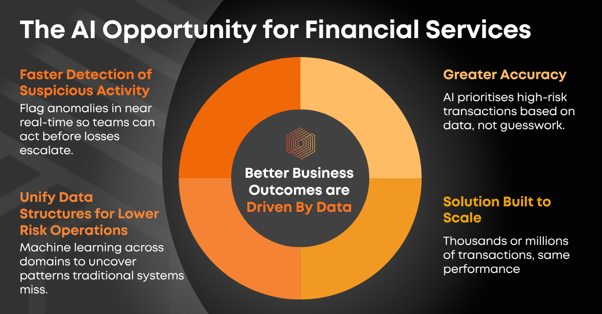
Oracle AIDP for Financial Services is designed to help institutions make faster and more consistent credit decisions, respond to fraud in real time, produce more accurate regulatory reporting, and deliver hyper-personalized service whether a customer is banking online, on a mobile device, or in a branch. The outcomes it targets are measurable, covering shorter time to insight, lower operational cost, and stronger risk and compliance posture.
Delivering against those outcomes depends on one thing first, which is the data sitting underneath the AI.
This is the issue that stalls most financial services AI programes. Data readiness can be framed in three parts. The first is that the data is rarely AI-ready or consistently trusted, because it sits locked inside siloed CRM, risk, and ERP systems, where duplication, inconsistent formats, missing metadata, and residency requirements create incomplete views and complicate regulatory reporting. The second is that off-the-shelf models lack banking context, so they misread complex agreements, exposures, and events, and terminology that varies by region and business type erodes the accuracy of term sheets, KYC files, and regulatory outputs. The third is that even good insight fails when it cannot integrate with core banking, payment, AML/KYC, trading, and decision engines, so it arrives too late and forces manual workarounds.
Until the underlying data is unified, governed, and given financial meaning, AI projects tend to stall before they reach production. That is the problem AIDP for Financial Services is built to address.
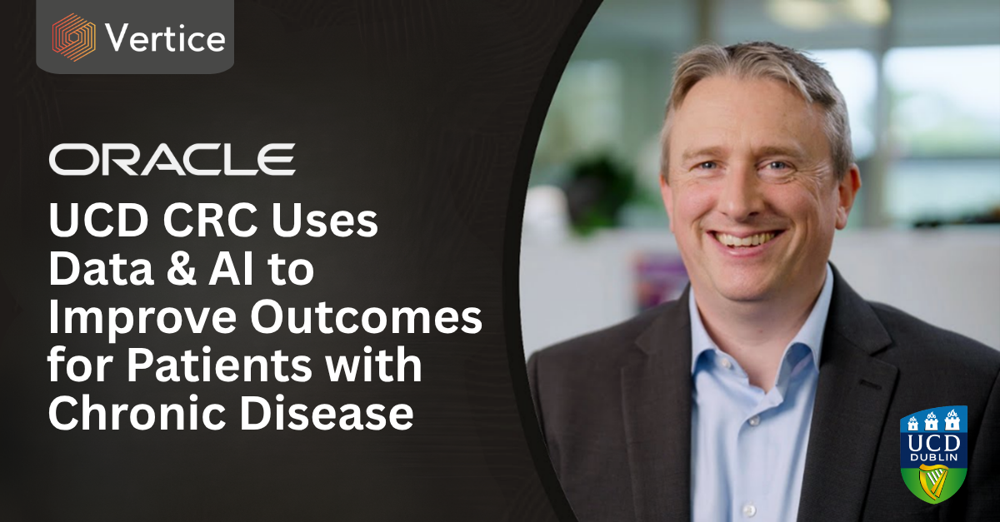
We saw this play out firsthand in a recent deployment we built an AI-powered patient companion for respiratory conditions on Oracle AIDP. The data challenge there was patient data governance, and honestly, the pattern is the same one you see in banking and insurance, just with different labels. Swap patient records for customer financial data, transaction histories, or underwriting records, and the bottleneck is identical: the AI and analytics layer is ready long before the data is. One of the things that saved us roughly 12 to 14 weeks was using synthetic data to validate the use case before anyone had to touch production data. And if you think about a bank trying to prove out a fraud detection model or a credit decisioning agent, that same approach applies, because the conversation you need to have with your compliance team is a lot easier when you can show them a working proof of concept built on synthetic data rather than asking for access to live customer records on day one.
What is Oracle AI Data Platform?
Oracle AI Data Platform combines four capabilities in a single environment:
A unified data foundation
AIDP provides a lakehouse architecture that brings structured and unstructured data into one place and removes duplication, with a unified catalog providing governance across all data and AI assets. For a financial institution, this means connecting deposit, loan, payment, CRM, risk, and ERP financials into a single trusted, real-time dataset that can serve Customer 360, risk modeling, and portfolio decisioning from one source of truth. Because AI needs data presented in a form models can reason over, the foundation also includes feature stores and vector stores alongside the established data lake and warehouse layers.
Built-in generative AI and agentic capability
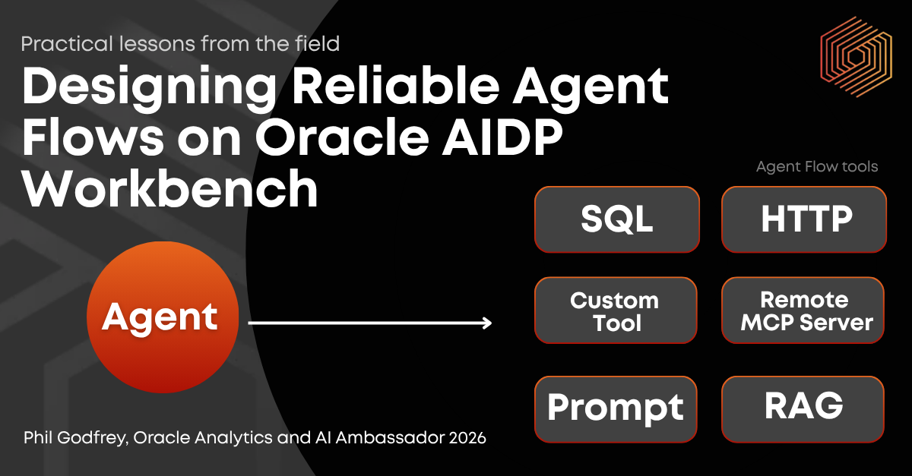
The platform includes integrated access to generative AI models, vector indexing, retrieval-augmented generation (RAG), and the tooling to build, deploy, and manage AI agents. It supports open standards including Agent2Agent (A2A) and Model Context Protocol (MCP), which allow agents to talk to each other and to combine a bank’s private data with foundational language models safely. An intelligence layer sits between the agents and those models, handling orchestration, runtime, hallucination checks, and model risk management so that agentic behaviour stays inside the institution’s risk tolerance.
Integration with the wider Oracle ecosystem
AIDP connects to existing enterprise systems through Zero-ETL and Zero Copy capabilities and supports multicloud and hybrid environments, with the ability to process data from on-premises and edge sources. For banking specifically, Oracle provides an Interconnect capability to bring data from legacy mainframe core systems into the modern platform, alongside a Cloud Native Fabric that lets each product run in the deployment model of choice, whether that is multi-tenant OCI SaaS, a bring-your-own-cloud strategy, or Oracle’s cloud-at-customer running inside the bank’s own data centre.
Enterprise-grade security and governance
The platform is built on Oracle Cloud Infrastructure (OCI) with the security, compliance, and governance controls required for regulated industries, including audit trails, role-based access, and a control-by-design layer that cuts across the whole architecture to keep entitlement, governance, and security consistent.
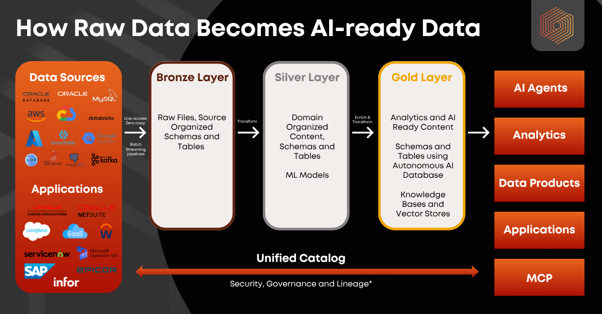
How does Oracle AIDP for Financial Services build on Oracle AIDP
Institutions can now start with connected and trusted banking data, a financial context layer, pre-built agents, and fully managed infrastructure. This shortens the path to proof of concept, analytics deployment, and AI experimentation, because much of the foundational work is already in place.
Because the data is centralized, standardized, and given financial meaning, the same platform can be reused across many domains. Once the governed banking data foundation exists, new applications become composable, AI becomes reusable, and experimentation becomes faster.
The app goes well beyond a simple diary. It combines the patient’s qualitative narrative with quantitative open data such as pollen counts, weather, humidity, and air quality. Using retrieval-augmented generation (RAG), it correlates what the patient describes with clinical and environmental data held in the platform, and offers personalized, real-time guidance. For example, it might explain that air quality was good locally but the pollen count was higher than normal, suggest staying indoors until conditions improve, and share a trusted resource such as the asthma action plan from the Asthma Society of Ireland.
This creates a complete and clinically useful picture of a patient’s health over time, blending the human experience of living with the condition with the clinical and environmental context around it.
What does this mean for Financial Services?
The financial services capability is a version of AIDP shaped for the data, workflows, and regulatory environment of banks, insurers, and capital markets firms. Three things distinguish it from a generic implementation
The platform’s AI tooling accelerated development of the chatbot and the analysis and reporting functionality. Its open framework let the team standardize diverse data types using common data models, which matters when you are combining spoken patient narratives with structured clinical and environmental data. Its lakehouse foundation unified that structured and unstructured data in one governed place. And because the work involves sensitive patient information, the security and governance built into AIDP, running on Oracle Cloud Infrastructure, gave the team a trusted platform to build on and to scale.
A financial services context layer
Oracle applies industry models that treat customers, accounts, products, transactions, exposures, and compliance metrics as first-class concepts, keeping insight such as liquidity, credit risk, and capital adequacy consistent across teams and regions and supporting frameworks such as Basel and IFRS from a single governed foundation.
The application was built on the underlying Oracle AI Data Platform, before the dedicated Oracle Life Sciences AI Data Platform variant was announced. That makes it one of the earliest deployments of its kind, and reflects Vertice’s position as the first to implement Oracle AIDP at scale. The story was featured on Oracle TV at Oracle AI World 2025.
A pre-built agentic banking architecture
The application was built on the underlying Oracle AI Data Platform, before the dedicated Oracle Life Sciences AI Data Platform variant was announced. That makes it one of the earliest deployments of its kind, and reflects Vertice’s position as the first to implement Oracle AIDP at scale. The story was featured on Oracle TV at Oracle AI World 2025.
Industry tooling and extensibility
Users work through familiar Oracle services such as Autonomous Data Warehouse, OCI Data Science, Oracle Analytics Cloud, Oracle Machine Learning, and OCI Data Catalog, and a financial services studio lets institutions extend the shipped agents and capabilities to suit their own products and processes.
Oracle AIDP for Financial Services use cases
Oracle’s financial services materials point to a number of areas the platform is designed to support. Each represents a business outcome rather than a technical capability.
Origination and credit decisioning
Experience and domain agents work across the originations lifecycle to speed application completion, predict delays, and produce faster, more consistent credit decisions, with human bankers kept in the loop for oversight.
Collections
Agents summarise collector calls to reduce handling time and check call tone and sentiment against regulatory rules, supporting a faster, lower-risk, and more compliant collections environment.
Fraud detection and financial crime investigation
AI agents collect and correlate data from across systems, generate investigation narratives, and surface the highest-risk cases, helping investigators cut the time spent on each alert while keeping a human decision-maker in control.
Risk, stress testing, and regulatory reporting
The platform supports scenario analysis and stress testing such as CCAR by retrieving requirements, building baseline and adverse scenarios, and running them against the bank’s own data and calculation engines, with results made available to leadership. Industry models keep capital, liquidity, and credit-risk reporting consistent across frameworks such as Basel and IFRS.
Corporate banking, cash flow forecasting, and supply chain finance
In corporate banking, agents consolidate balances and invoice data to forecast cash flow, then coordinate across banks and geographies using agent-to-agent protocols to arrange credit lines and onboard suppliers into supply chain finance programes.
Hyper-personalised customer service
Experience agents anticipate evolving customer needs and deliver tailored service across online, mobile, and branch channels, supported by predictive analytics for needs such as anticipating customer churn, identifying potential fraud, predicting credit defaults, and optimizing cash flow forecasting.
In addition to these defined use cases, the platform supports open-ended analysis. Teams can pose questions in natural language and let AI agents propose analyses for review and act within user-defined guardrails, with full visibility into how the data was used.
Oracle AIDP for Life Sciences: Use Cases and Faster Time to Value
Is Oracle AI Data Platform for Financial Services right for your organization?
There are three practical tests for whether AIDP for Financial Services belongs on your roadmap now.
The first is whether you can point to a concrete problem with a number attached to it, such as a regulatory reporting cycle you need to shorten, fraud losses you want to bring down, or a credit decision you need to make faster.
The second is whether you have a working picture of your own data, meaning you know what you hold, where it sits, and how well it is governed. When one is absent, the more valuable starting point is getting the data foundation in order before any technology is bought.
The third test that I think gets overlooked, and it comes from what we learned scaling the UCD programme. That project started with one engaged champion who used the system daily, someone who understood both the clinical and the operational context well enough to validate the output against their own real-world judgment. Over time, that one person’s credibility drove the programme from a pilot towards multi-year expansion. The same pattern applies in financial services, because adoption scales from a single credible internal user, but the trust-building looks different. In banking or insurance, that champion has to bring compliance and risk stakeholders into the room from the outset, because their sign-off is part of what “trusted” means in a regulated financial environment. So if you’re evaluating AIDP for Financial Services, it’s worth asking yourself: do you have that person? Someone senior enough to sponsor the use case and close enough to the operational detail to know whether the output is right? If you do, you probably have your starting point
To read more on these readiness signals, why data governance is so often the sticking point, and how we assess it, check out our companion piece: Oracle AIDP Readiness: How to Tell If You’re Ready (and What to Do If You’re Not).
What to Do Next
To explore whether AIDP for Financial Services fits your organization, take a look at our Oracle AI Data Platforms Services, or Contact Us.
Frequently Asked Questions
What is Oracle's agentic platform for banking?
Announced on 3 February 2026 at the Oracle Financial Services Summit in New York, it is an enterprise-class suite of AI-infused applications, design tools, frameworks, and pre-built AI agents. It embeds AI experiences and decisioning into customer engagement and core banking processes, with bankers acting in a human-in-the-loop role.
How does Oracle AIDP for Financial Services differ from the general platform?
The general platform provides the unified data foundation, generative AI, and agentic tooling. The financial services capability adds an industry context layer that treats customers, accounts, products, transactions, exposures, and compliance metrics as first-class concepts, together with pre-built banking agents and tooling aligned to banking workflows, which speeds time to value.
What banking agents are available?
The first retail agents include Product Brochure Generation, Smart Assist for Application Insights, Application Tracker, Qualitative Analysis and Credit Decisioning, Collector Call Summarization, and Call Compliance Check. Oracle has stated these are an early sample of hundreds of retail and corporate banking agents planned over the following twelve months.
What tools does the platform include?
Oracle Autonomous Data Warehouse for SQL-based analysis, OCI Data Science for notebook-based modeling in Python, R, and Spark, Oracle Analytics Cloud for visualization, Oracle Machine Learning for in-database modeling, and OCI Data Catalog for governance and metadata management.
How does AIDP handle legacy core banking data?
Oracle provides an Interconnect capability to bring data from legacy mainframe core systems into the modern platform, along with Zero-ETL and Zero Copy connections to enterprise applications across multicloud and hybrid environments.
How does the platform support risk and compliance?
The team took the concept from idea to a working pilot in a number of weeks, prototyping a demonstrator quickly thanks to the AI tooling and managed infrastructure in AIDP.It keeps risk and compliance metrics such as liquidity, credit risk, and capital adequacy consistent across teams and regions, embeds AI into compliance workflows with audit trails and role-based access, and keeps bankers in a human-in-the-loop role for oversight and governance.
How should an organization choose an AIDP implementation partner?
Look for live, in-production AIDP implementations, named customer references you can speak to, an active Oracle partnership, and vertical experience in your sector. The right partner takes you from a defined business problem to a working use case in weeks rather than quarters. Vertice was the first to implement Oracle AIDP at scale.
About John Fitts
John Fitts is a senior business strategist with 25 years translating between the boardroom and the technology stack. As US Vice President for Vertice and CEO of Fairfax Intel, he partners with C-suite leaders on the question most AI and data programs skip: not how, but why.
Contact us today to arrange an assessment or email:

John Fitts
Senior VP North America