Author: John Fitts
The 30-second answer
Oracle AI Data Platform (AIDP) is a cloud-based platform that brings enterprise data, generative AI models, and AI agents together in a single, governed environment. When applied to life sciences, it provides a foundation for organizations across pharmaceuticals, medical devices, clinical research, and healthcare to unify their data and apply AI to research, clinical trials, post-market safety, and commercialization activities.
Oracle launched the general AI Data Platform in October 2025 and announced Oracle Life Sciences AI Data Platform in January 2026. The latter is pre-populated with more than 129 million de-identified longitudinal Oracle Health Real-World Data (OHRWD) records, alongside the customer’s own data and any third-party sources they choose to bring in. Throughout this article, “AIDP” refers to the underlying platform. Where the distinction matters, the Life Sciences variant is named directly.
Why does the Oracle AIDP for Life Sciences conversation matter now?
Oracle AIDP for Life Sciences is designed to help organizations accelerate drug development, run faster and smarter clinical trials, monitor post-market safety, and generate the evidence needed for commercial and regulatory decisions. The outcomes it targets are measurable: shorter time to insight, earlier identification of disease, deeper understanding of patient populations, and reduced operational cost.
Delivering against those outcomes depends on one thing first. Not the AI, but the data underneath it.
This was the central message from Oracle leadership at Oracle AI World 2025. Speaking on the impact of AI on healthcare and life sciences, Seema Verma, Executive Vice President and General Manager of Oracle Health and Life Sciences, identified data as the defining issue.
“One of the big problems that is driving those inefficiencies is data and the lack of data or too much data or understanding what the data means,” she said. “And so, this is like the perfect use case for AI.”
She went further on the relationship between data and AI: “It’s not enough to just be able to use AI. You have to be able to, first of all, bring all the data together, and you have to make sense of the data, and you have to make sure the data is clean so that the AI can work.”
The same logic applies across pharmaceuticals, medical devices, and clinical research. Until the underlying data is unified and governed, AI projects tend to stall before they reach production. That is the problem AIDP for Life Sciences is built to address.
What is Oracle AI Data Platform?
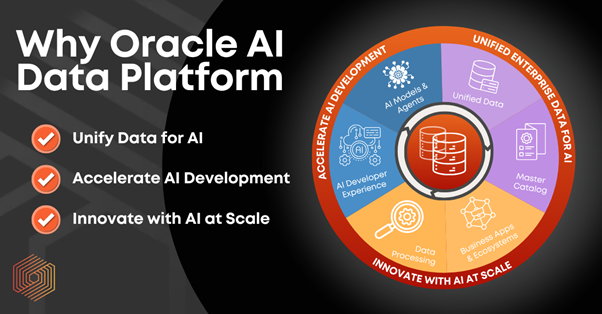
Oracle AI Data Platform combines four capabilities in a single environment:
A unified data foundation
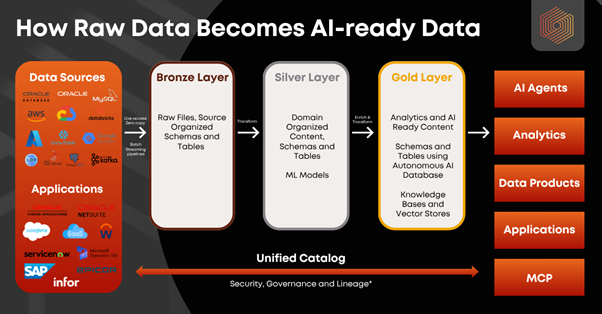
AIDP provides a lakehouse architecture using open formats such as Delta Lake and Iceberg, designed to eliminate data duplication and bring structured and unstructured data into one place. A unified catalog provides governance across all data and AI assets.
Built-in generative AI and agentic capability
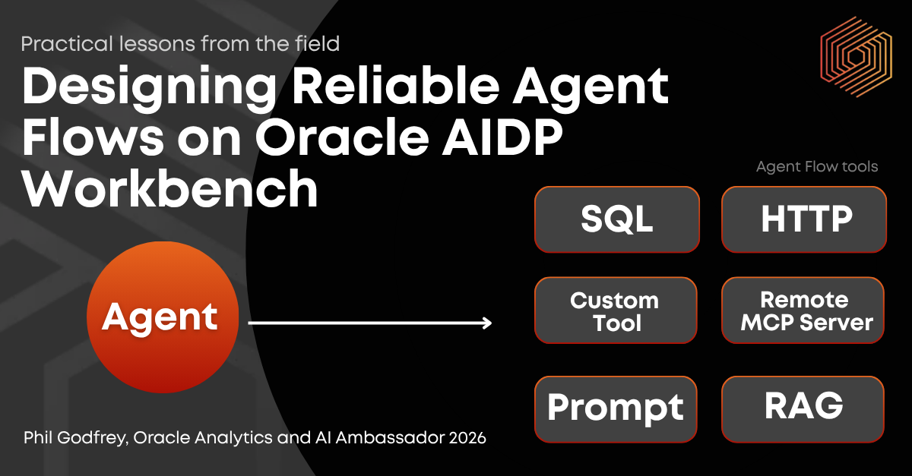
The platform includes integrated access to generative AI models, vector indexing, retrieval-augmented generation (RAG), and tools for building, deploying, and managing AI agents. Oracle’s Agent Flows allows business users to interact with multiple agents through a single interface, and the platform supports open standards including Agent2Agent (A2A) and Model Context Protocol (MCP).
Integration with the wider Oracle ecosystem
AIDP connects to Oracle Health applications and existing enterprise databases through Zero-ETL and Zero Copy capabilities. It also supports multicloud and hybrid environments, with the ability to process data from on-premises and edge sources.
Enterprise-grade security and governance
The platform is built on Oracle Cloud Infrastructure (OCI) with the security, compliance, and data governance controls required for regulated industries.
How does Oracle AIDP for Life Sciences build on Oracle AIDP
The Oracle Life Sciences AI Data Platform is a version of AIDP shaped for the data, workflows, and regulatory environment of life sciences organizations. Three things distinguish it from a generic implementation.
Pre-loaded real-world data
The platform provides access to Oracle Health Real-World Data, a dataset of more than 129 million de-identified longitudinal patient records sourced through the Oracle Learning Health Network. The data is delivered in both the Oracle Core Data Model and the Observational Medical Outcomes Partnership (OMOP) Common Data Model, with mapping to standard clinical ontologies such as ICD-10 and SNOMED. De-identification follows the Expert Determination methodology defined in the HIPAA Privacy Rule.
Industry-specific tooling
Users access the platform through Oracle Autonomous Data Warehouse for SQL-based analysis and cohort identification, Oracle Cloud Infrastructure Data Science for notebook-based modeling in Python, R, and Spark, and Oracle Analytics Cloud for visualization and reporting. OCI Object Storage supports unstructured and semi-structured data ingestion.
Service variants for different organization types
Oracle offers the platform in distinct service configurations, including a Pharma Cloud Service and a Research Institutes Cloud Service. Each is sized differently and provisioned with the OCI services appropriate to that use.
It is worth noting one specific limitation: the OHRWD Patient Dataset and the insights generated from it are not regulatory grade and are not approved for use in regulatory submissions. The platform supports the workflows around regulatory activity, but the dataset itself is intended for research, not filing.
What does this mean for Life Sciences?
Customers can start with pre-curated healthcare datasets, built-in AI tooling, existing healthcare ontologies and fully managed infrastructure. This means faster delivery of proof-of-concept timelines, analytics deployment, cohort analysis, and AI experimentation.
Because the data is centralized and standardized, organizations can reuse the same platform across many domains. Once the governed healthcare data foundation exists, new applications become composable, AI becomes reusable and experimentation becomes faster.
Oracle AIDP for Life Sciences use cases
Oracle’s announcement of the Life Sciences AI Data Platform identified a number of use cases the platform is designed to support. Each represents a distinct business outcome rather than a technical capability.
Label expansion
Organizations can use the platform to identify potential indications for existing therapies by analyzing real-world patient data alongside their own clinical evidence, supporting commercial and regulatory strategy for approved products.
Health Economics and Outcomes Research (HEOR)
The platform supports population-level analysis to evaluate the cost, effectiveness, and real-world impact of treatments, work that increasingly determines reimbursement decisions and market access.
Synthetic control arms
Using real-world data as a comparator, organizations can construct synthetic control arms for clinical trials, reducing the need for placebo cohorts in certain study designs and shortening trial timelines.
Post-market safety monitoring
AI agents can monitor disparate sources of safety data, surfacing signals earlier than manual processes typically allow.
Regulatory submission support
While the underlying patient dataset is not itself regulatory grade, the platform supports the analysis, evidence generation, and workflow management that contribute to submissions.
In addition to these defined use cases, Oracle’s platform supports open-ended hypothesis generation. A researcher can ask a question in natural language, and AI agents will clarify intent, propose analyses for review, and act within user-defined guardrails, with full visibility into data lineage.
Oracle AIDP for Life Sciences Case Study: UCD Clinical Research Centre
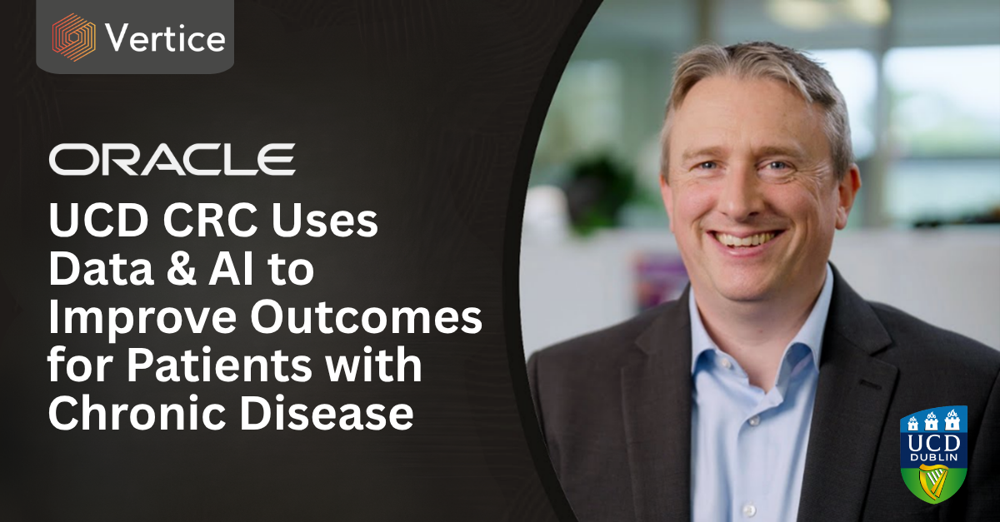
We built an AI-powered patient companion application for asthma and chronic obstructive pulmonary disease (COPD) on Oracle AI Data Platform, in partnership with University College Dublin Clinical Research Centre (UCD CRC), the largest clinical research centre on the island of Ireland. The application was built on the underlying Oracle AI Data Platform rather than the Oracle Life Sciences AI Data Platform variant, which was announced subsequently. UCD CRC handled the clinical study design and managed the research requirements. We handled the technical delivery, including the lakehouse, the AI-elements, and the application itself.
The application captures the patient’s experience in their own voice, in the moment it happens, and uses retrieval-augmented generation to correlate that narrative with clinical and environmental data. The pilot is live, the partnership is ongoing, and we are now working with UCD CRC to explore further use cases beyond respiratory disease using the same architecture.
Is Oracle AIDP for Life Sciences right for your organization?
Two signals tell you that AIDP for Life Sciences is worth a serious look. First, you can name a specific use case tied to a measurable business outcome, for example, whether that is shortening trial reporting cycles, or expanding the indications for an approved therapy. Second, you have a baseline understanding of what data you hold, where it lives, and some level of governance around it. If both are in place, the conversation is a productive one. If either is missing, the right first step is foundational data work, not platform procurement.
A fuller breakdown of the readiness signals, the most common gap (data governance), and the framework we use to assess it is covered in our companion piece: Oracle AIDP Readiness: How to Tell If You’re Ready (and What to Do If You’re Not).
What to Do Next
To explore whether AIDP for Life Sciences fits your organization. Contact Us.
Frequently Asked Questions
What is Oracle AI Data Platform?
Oracle AI Data Platform (AIDP) is a cloud-based platform that connects generative AI models with enterprise data, applications, and workflows. It is built on Oracle Cloud Infrastructure, Oracle Autonomous AI Database, and OCI Generative AI service. Oracle announced general availability in 2025.
What is Oracle Life Sciences AI Data Platform?
A generative AI-enabled solution announced in January 2026, designed for pharmaceutical, medical device, research, and life sciences organizations. It supports use cases across research and development, clinical trials, post-market safety, and commercialization.
Oracle AI Data Platform vs Oracle Life Sciences AI Data Platform
The Original AI Data Platform (AIDP Workbench) and Life Sciences AI Data Platform which we refer to as a “flavours” (FAIDP would be another flavour) differ mainly in prebuilt content. AIDP Workbench is a blank canvas where everything needs to be built from the ground up. The variants, like Life Sciences AI Data Platform, include prebuilt aspects aligned to a specific industry or line of business, such as Oracle applications, KPIs, and agents, enabling faster time-to-value.
What is Oracle Health Real-World Data?
A dataset of more than 129 million de-identified longitudinal patient records sourced through the Oracle Learning Health Network. It is delivered in the Oracle Core Data Model and the OMOP Common Data Model, with mapping to ICD-10 and SNOMED. De-identification follows the Expert Determination methodology defined in HIPAA Privacy Rule § 164.514(b)(1).
What types of patient data are included?
Demographics, vitals, test results, medications, and encounter specifics including diagnosis, symptoms, and provider details. Not all fields are completed for all patients.
Can the data be used for regulatory submissions?
No. The Patient Dataset and the insights derived from it are not regulatory grade and are not approved for use in regulatory submissions.
Can the platform process genetic data?
No. The Cloud Service cannot currently receive or process genetic data.
What use cases does the platform support?
Oracle has identified label expansion, population-level Health Economics and Outcomes Research, synthetic control arm generation, post-market safety monitoring, and regulatory submission support. The platform also supports open-ended hypothesis generation through AI agents operating within user-defined guardrails.
What tools does the platform include?
Oracle Autonomous Data Warehouse for SQL-based analysis, OCI Data Science for notebook-based modelling in Python, R, and Spark, Oracle Analytics Cloud for visualization, and OCI Object Storage for unstructured data.
What service variants are available?
Oracle offers a Pharma Cloud Service pre-populated with the Patient Dataset, and a Research Institutes Cloud Service available as a Hosted Named User service with optional Patient Dataset Records. Each is sized and provisioned differently.
How does AIDP integrate with other Oracle products?
It connects to Oracle Cloud Infrastructure, Oracle Life Sciences AI Application Suite, Oracle Fusion Cloud SCM and Sales, and Oracle Health AI Application Suite. The general AIDP also supports Zero-ETL and Zero Copy connections to Fusion, NetSuite, and other enterprise applications across multicloud and hybrid environments.
What is an example of AIDP being used in clinical research?
University College Dublin Clinical Research Centre and Vertice built an AI-powered application for patients with asthma and COPD using Oracle AI Data Platform. Oracle Health and Baylor College of Medicine have also announced a collaboration to advance research into alcohol-related liver disease using the platform and Oracle Health Real-World Data.
How long does it take to implement Oracle AIDP for Life Sciences?
Any implementation is dependent on the business, functional and technical requirements. However, the typical pilot is a 4-week sprint where we create outcome use cases. This is followed by 4-week project phases where we create a portfolio of production-ready AI use cases that can be scaled across the organization. You attain ROI via in-house AI Innovation Library of working use cases to then derive your budget internally to productionize.
How should an organization choose an AIDP implementation partner?
Look for live, in-production AIDP implementations, named customer references you can speak to, an active Oracle partnership, and vertical experience in your sector. The right partner takes you from a defined business problem to a working use case in weeks, not quarters. Vertice was the first to implement Oracle AIDP at scale and has proven delivery in life sciences and clinical research.
About John Fitts
John Fitts is a senior business strategist with 25 years translating between the boardroom and the technology stack. As US Vice President for Vertice and CEO of Fairfax Intel, he partners with C-suite leaders on the question most AI and data programs skip: not how, but why.
Contact us today to arrange an assessment or email:

John Fitts
Senior VP North America