

Author: Jason Beattie
Getting support tickets about load balancer limits? The problem probably isn’t Oracle Cloud. It’s the architecture underneath it.
A surprising number of Independent Software Vendors running multi-tenant platforms on Oracle Cloud Infrastructure eventually receive a message that looks something like this:
“Your tenancy has reached its load balancer limit.”
For many organisations, this moment arrives during growth.
A new customer needs onboarding. A new environment needs provisioning.
And suddenly the infrastructure that once felt scalable… isn’t.
At first glance, it’s easy to assume the platform is the problem. Limits exist in every cloud provider, after all.
But in the vast majority of cases, the cloud isn’t the blocker.
The architecture is.
More specifically, it’s often the architecture that was designed early in the journey – sometimes by internal teams, sometimes by external providers – when the platform only had a handful of customers and scale wasn’t yet a concern, or during a rushed migration to the cloud where immediate delivery took priority over long-term scalability.
The Pattern That Quietly Breaks ISV Platforms
One pattern appears again and again in hosted enterprise software environments – particularly platforms built around applications such as Primavera, Oracle E-Business Suite, JD Edwards, PeopleSoft, Unifier, Aconex, and IBM Maximo.
Each customer environment is exposed through its own port.
At first this feels logical. It separates tenants cleanly and allows environments to be provisioned quickly.
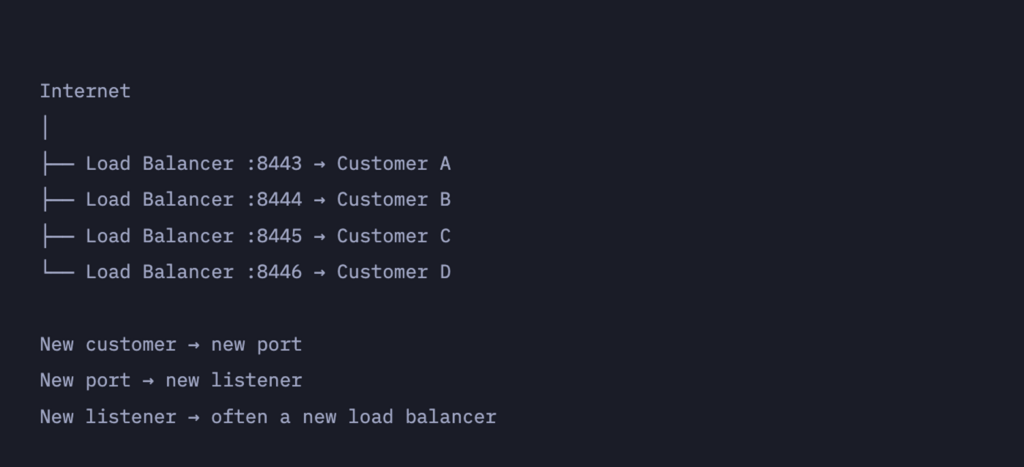
It works perfectly when there are five customers.
It works when there are ten.
But by the time platforms reach dozens of customers, the underlying architecture begins to show its age – and organisations start encountering limits that were never meant to be part of the growth journey.
REALITY CHECK
Cloud limits rarely stop platforms from scaling. Architectural patterns that grow infrastructure alongside customers eventually do.
The Question ISVs Should Be Asking
When infrastructure limits begin appearing during growth, the first reaction is often to request higher quotas or deploy additional resources.
But the more important question is this:
Is the architecture designed for where the platform is going – or where it started?
Modern multi-tenant platforms should not require new infrastructure every time a customer is onboarded.
When they do, operational complexity increases alongside the business. Eventually the platform itself becomes the constraint. The good news is that these issues are often solvable with a careful architectural review.
Contact us today to arrange an assessment or email:

Jason Beattie
Senior Architect and Cloud Operations Manager